
St. Julien Canadian Memorial, Vancouver Corner, Ypres.
In Flanders Fields:
In Flanders fields, Canada aided by the many British immigrants that swelled her ranks; forged her reputation during the first gas attacks at the 2nd Battle of Ypres, in 1915. One can only try to imagine the scenes of desperation and horror. Certainly, Canadian John McCrae would never be the same, his optimism and infectious smile gone forever.
John McCrae was 2nd in command of 1st Brigade the Canadian Field Artillery. Based near Essex Farm Ypres during that intense period, this titanic struggle inspired McCrae to write his enduring epitaph, “In Flanders Fields” which is synonymous with remembrance and the Great War.
Essex Farm:
Essex Farm is located in Boezinge (modern spelling, previously Boesinghe) Ypres, Belgium. Land to the south of Essex Farm was used as a dressing station and cemetery from August 1915 – August 1917.
The cemetery was designed post-war by Reginald Bloomfield (who also designed the Menin Gate) and contains 1200 burials. A large obelisk situated on a small mound towers above Essex Farm. Dedicated to the 49th West Riding Division, their dead from the first phosgene attacks in December 1915, are buried in plot 1.
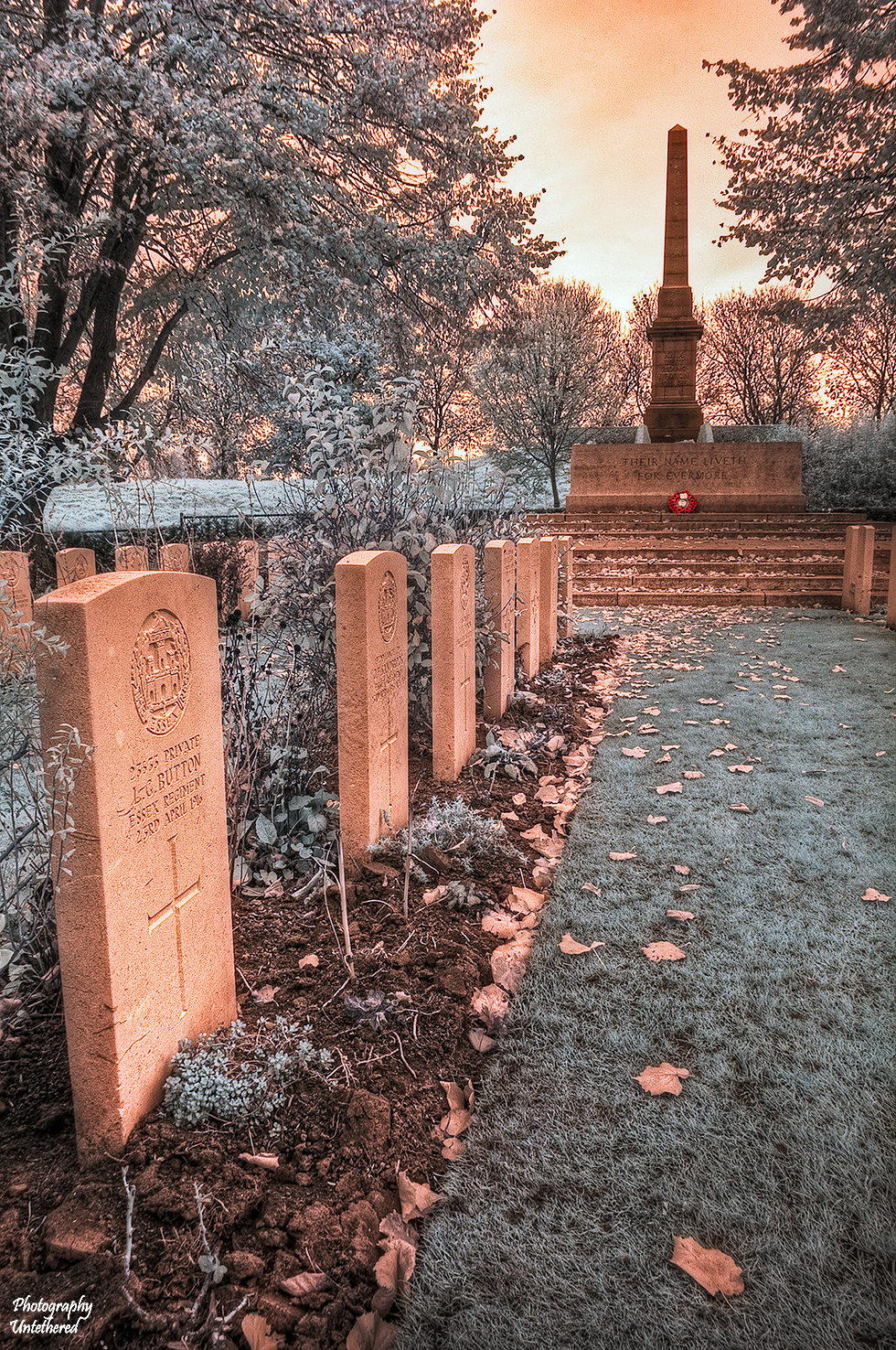
Essex Farm Cemetery, Ypres, Flanders, Belgium.
John McCrae:
John McCrae son of Col David McCrae and Janet Simpson Eckford, was born on the 30th of November 1872 at Guelph, Ontario, Canada. Raised within a Presbyterian family, John McCrae was brought up with strong spiritual values and high principles. Described as warm and sensitive, he had a remarkable passion for people and animals, and it would be these character traits that would serve him well at Essex Farm.

Lt Col John McCrae (Source)
At the outbreak of the Great War John McCrae had a pathology practice which he set up in 1905, shortly after graduating from Toronto Medical School. Having served as an artillery subaltern during the Boer War he was not naive to the carnage a modern conflict in Europe would bring. Nevertheless, the fear of stopping home whilst others were fighting was motivation enough to re-enlist.
“Hades” and the 1st Brigade the Canadian Field Artillery:
On April 22nd, 1915, John McCrae’s unit, the 1st Bde CFA, had orders to move from reserve positions at Vlamertinghe towards Ypres. There they would await further orders to move into position near Brielen Bridge No.4 on the Yser Canal. This was one of the main routes up to the front lines described by one veteran as, “A terrible place and reminded me of death, mud, fear and the abandonment of Christianity.”
What was to greet John McCrae and the men of 1st Bde CFA en route to Ypres, was a vision of hell. Desperate crowds of French Algerian troops some on horseback others on foot, and civilian refugees intermingled with transports of all descriptions surged towards them.
With expressions of hopeless desperation, forlorn figures of civilian women, children, and old men passed by. Bloodied and limbless soldiers amongst anxious groups of retreating combatants caste a wretched sight. Worse still, many lay writhing on the road with foaming mouths and protuberant eyes. Some, with hands taut around their throats, clawed in a frenzy of desperation.
The Canadians could offer little in the way of assistance to this dejected horde of human suffering. Meanwhile, shells continued to pitch into the medieval town. In the evening dimness, numerous blazes now illuminated the towers: creating a nightmarish backdrop to this chaotic abode of the damned.
If it wasn’t obvious to the Canadian gunners at this point, ear-splitting air bursts of shrapnel shells suddenly consumed the air above them; and could signal only one thing? A major enemy attack was underway and a sinister one at that. To prevent reinforcement, all routes to the front line were now be targeted by German concentrated artillery fire.

Essex Farm Cemetery, Ypres.
Imagine the anxiety that swelled within the witnesses to this spectacle of war butchery. The instinct for self-preservation strongest when confronted with such horror. While awaiting further orders, each man now wrangled with his conscience, the overwhelming desire to head for safety. Comradeship forged in training would now assist each man in holding his nerve.
The Furnace of Battle:
This would soon be tested nevertheless, in the furnace of battle. It would be a stern test. John McCrae plotted positions for the guns should they have to deploy where they stood. Directives, however, would take them towards that inferno, and it was clear to all that “Hades” was upon them.
In the early hours of the 23rd of April, the Brigade moved to forward positions on the Yser Canal to support the French counter-attack. Here they would stay for seventeen days. Almost immediately they were in action and under heavy gunfire, the enemy being only 2000 yards to their front. Guns were dug in and what protection could be afforded from the canal bank was quickly exploited. This soon became a rabbit warren of shallow dugouts. Throughout, the brigade was subject to accurate and prolonged shelling.
17 days of Hades:
Here, in this exposed precarious portion of the salient, John McCrae would spend what he described as “17 days of Hades. A nightmare of the bitterest of fights“. Subjected to periods of almost constant shell fire of all calibres, the brigade would suffer higher than normal casualties.
The chances of being overwhelmed by the Germans was a constant threat. Not knowing for sure how tenuous the French line to their front was, caused extreme anxiety. The angst within John McCrae led to a loss of appetite, which at times led him to force food down even though suffering from nausea. That aside, the constant din he found irritating, which produced a feeling of anger as well as more apprehension. Nevertheless, like everyone else, he had no option but to carry on with the task at hand.
“Another day of heavy actions, but last night much French and British artillery has come in, and the place is thick with Germans. There are many prematures (with so much firing) but the pieces are usually spread before they get to us. It is disquieting, however, I must say. And all the time the birds sing in the trees over our heads.” Diary John McCrae.

Advanced Dressing Station: Concrete Dugouts, Essex Farm. Built 1917.

The Road:
Keeping busy was the key to occupying the mind. McCrae would undertake any task that came his way. He would attend the gun lines and await reports of casualties of which he would treat and prepare for evacuation overnight via Ypres. The road from Ypres, unfortunately, ran parallel to their position on the canal bank, so was shelled so heavily it was too risky for the Field Ambulances to evacuate the wounded by day. This inappropriate situation caused acute suffering to the soldiers involved.
Many endured horrific head injuries which made their chances of survival non-existent. And so the Canadian plots filled rapidly. The importance, however, of supplying the Brigade with ammunition was a different priority, and horses bravely ran the two-mile gauntlet of fire along the road from Ypres.
Lined with poplar trees the road was easily spotted, and the huge volumes of dust struck up by the ammunition columns made an easy target for the German guns. The enemy would even target the road just on the assumption someone would be on it.
A Nightmare Existence:
McCrae’s eight by eight-foot dugout was burrowed into the west side of the canal bank. This afforded an ample view of the carnage on the road. McCrae would shudder in anticipation when he saw troops and horses approach, and then watch the unfortunate bowled over and mutilated by shells. Moreover, during darkness, the verbal agonies of wounded horses and the hideous groans of men; made for a tormented existence.

1916 Sketch of Essex Farm Advanced Dressing Station by A R Watt of the 69th Field Ambulance
The Fight Back:
I should not give the impression that all was one-sided and that the brigade were just hapless victims of a wretched situation. The return fire from the brigade guns was perpetual; to the extent that the Canadians were forced to use sacking in which to operate the red hot gun levers. McCrae certainly felt that they had given as good as they got, and what is certain, the Germans did not breakthrough.
Scores of German attacks with preliminary accurate bombardments of high explosives, gas, and shrapnel, were driven back with the support of the Brigades guns time and time again. Whilst this period was of intense hardship for the Canadians, the tortures of those on the offensive would be extreme.
Pain and Suffering:
To keep launching attacks and be constantly repulsed would have been harrowing. Envisage for a moment been involved in such an attack, if, in fact, we possess the ability to conceive such things without first-hand acquaintance. Knowing the consequence. Pain. Suffering. Then imagine the internal torment as one waits to go into the fray once more, perceptive of things to come.
Would you advance with the same fortitude? Would you gaily spring forward to what awaits as some memoirs would lead us to believe? Or would you hang back and go through the motions, and let the instinct to stay safe take over?
The Germans certainly had it tough, and once the first surprise attack with gas had been repulsed and the initiative lost, that initiative was unlikely to be regained. It would, nonetheless, take extreme gallantry and fortitude on behalf of the defenders to wear down the reckless resolve of German attacks.
Relief:
On May 9th the Brigade left the line. John McCrae picked up his horse Bonfire, who he had left in the care of his groom at a farmyard further to the rear, and rode the sixteen miles to billets and out of the firing line. Although extremely fatigued, the Brigade was glad to be clear of their experience at Essex Farm, and few men would complain of the long slog to the rear.
McCrae was informed that they would return to the line very soon but he was unperturbed, for he believed that no place could be worse than where he had just come from. For John McCrae, however, his destiny was to be No. 3 General Hospital at Boulogne. Posted there June 1st, 1915 he would never serve at the front again.
The sadness of leaving those who he had bonded with throughout the ordeal at Essex Farm, would prove as heartfelt as the sufferings that were “17 Days of Hades”. Nevertheless, orders were orders, and McCrae would utilise his medical skills at Boulogne.
No. 3 General Hospital at Boulogne:
The experience on the Yser Canal, although short, would leave an indelible mark upon John McCrae. It was said, his desire for solitude was sought around the roads and lanes of Boulogne, with his horse Bonfire, and dog Bonneau. His gaiety now subdued was often replaced with periods of irritation, and his youthful looks were gone.

Lt. Col. John McCrae, with his beloved horse Bonfire and dog Bonneau.
Let’s not forget, however, that whilst at Boulogne the impact of war would be ever-present. As the great struggle continued casualties soon became unremitting. That, combined with chronic asthma continually aggravated by living and working in such an extreme environment, would augment his moods and ageing.
John McCrae was a Gunner by heart and no doubt he longed to be with his battery. Certainly, no battle honours could be won at No.3 General Hospital, Boulogne. But this unsung and valiant work, like many jobs in the rear, whilst largely unrecognised, was paramount to the war effort and saved lives in the thousands.
Pneumonia:
The service John McCrae gave during the Great War took its toll, and ultimately his life. He succumbed to pneumonia on the morning of the 28th January 1918. He would pass from this world not knowing whether the torch thrown from failing hands would continue to be held high, or if indeed the reward of victory would be theirs? It would take a further 10 months of intense fighting and exact a price in casualties that would dwarf the previous years before victory could be secured.
“17 Days of Hades” condensed into fifteen lines:
John McCrae, and “In Flanders Fields”, would become synonymous with the Great War. Published in the December 1915 issue of punch, there are many legends as to why McCrae wrote this poem. All agree, however, it was written during the period at Essex Farm.
It’s more than probable that it wasn’t a specific event on the Yser Canal that inspired McCrae to compose it. After all, McCrae had studied poetry for many years. At Essex Farm when time allowed, poetry would have provided a distraction from the nervous tension.
Nevertheless, we know that “In Flanders Fields” is the profound thoughts of a man thrust into the crucible of a war that is now out of living memory. Sights, sounds, and fears of “17 Days of Hades”, condensed into fifteen lines.
In Flanders fields the poppies blow
Between the crosses, row on row,
That mark our place; and in the sky
The larks, still bravely singing, fly
Scarce heard amid the guns below.We are the Dead. Short days ago
We lived, felt dawn, saw sunset glow,
Loved and were loved, and now we lie
In Flanders fields.Take up our quarrel with the foe:
To you from failing hands we throw
The torch; be yours to hold it high.
If ye break faith with us who die
We shall not sleep, though poppies grow
In Flanders fields.
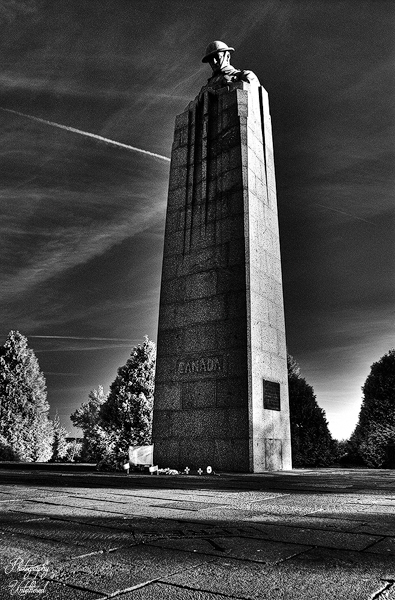
“The Brooding Soldier” Vancover Corner, Ypres.
Over 100 years have elapsed since that experience at Essex Farm, nonetheless, John McCrae’s “In Flanders Fields”, resonates still; in perpetual remembrance of that generation’s sacrifice.
The website is self-funded, and my work is free. All profits from the sites product links go to SightSavers; if you have enjoyed any aspect of this site please consider a giving a donation here. No one should go blind from avoidable causes. How many people’s sight will you help us save today?
Fragmented Memory 🙂
Disclosure: Photography Untethered is a participant in the Amazon Services LLC Associates Program, an affiliate advertising program designed to provide a means for sites to earn advertising fees by advertising and linking to Amazon.co.uk


